
This Week in Tech: The AI Price War Just Made Automation Affordable for Your Small Business
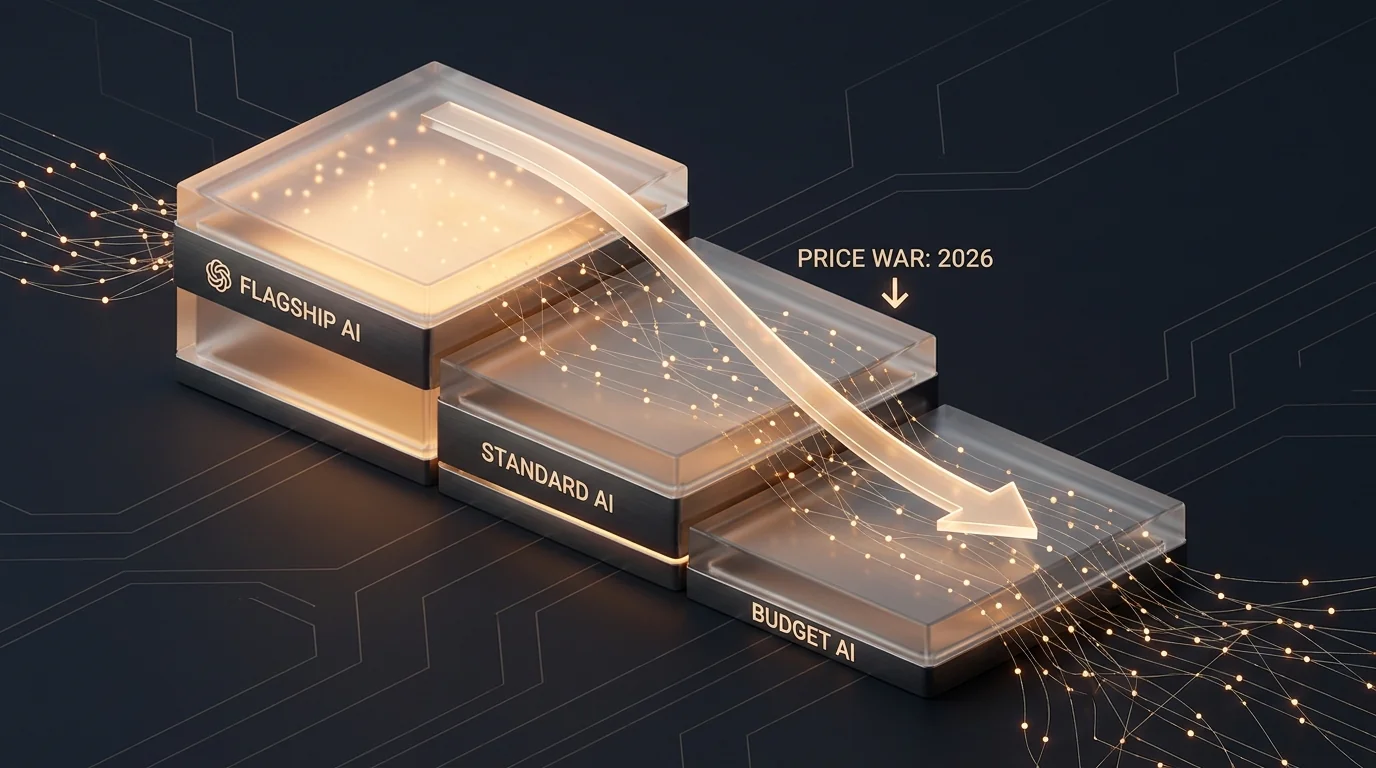
Two flagship AI model launches in the same week quietly cut the cost of running agents. Here's what OpenAI's GPT-5.6 tiers, Anthropic's Claude Sonnet 5, the compute crunch, and Washington's new rules mean for your small business.
By the PointWake Team
Reviewed by Jonathan Guy, Founder. Generative AI certificate, UT Austin McCombs School of Business.
Published Jul 6, 2026 · 6 min read
The week in one line
If you run a small business and you've been waiting for AI automation to get cheaper before you commit, this was the week to pay attention. Two of the biggest model makers shipped new lineups within a day of each other, and both moves point the same direction: the per-task cost of putting an AI agent to work on your operations just dropped again. Add a real infrastructure squeeze and a fresh set of rules coming out of Washington, and you get a clear picture of where this is heading. Here's the roundup, and what each story actually changes for the businesses we work with.
The headline: running an AI agent got noticeably cheaper
On June 30, Anthropic launched Claude Sonnet 5, positioning it explicitly as a cheaper way to run agents, with introductory pricing of $2 per million input tokens and $10 per million output tokens through August 31, then $3 and $15 after (TechCrunch). A day earlier, OpenAI previewed a three-model family priced by job size: GPT-5.6 Sol (the flagship) at $5 in / $30 out, Terra (built for high-volume business tasks like customer support and document analysis) at $2.50 / $15, and Luna (for routine automation like drafting and summarizing) at $1 / $6 (VentureBeat). Why it matters: the model's price has almost never been your real constraint, but the tiering tells you something useful. Not every task deserves the flagship. Answering a routine customer email, tagging an inbound lead, or drafting an invoice reminder is a budget-tier job. Reserving the expensive model for genuinely hard work and routing everyday volume to the cheap, fast tier is exactly how you keep an automation's monthly bill in the double digits instead of the hundreds. It's the single biggest lever most owners miss.
The quieter story: agents that split up the work
Buried in OpenAI's announcement was a feature with bigger operational implications than the price cut: an ultra mode that brings in subagents to split up and accelerate complex projects rather than forcing everything through a single agent (OpenAI). Translated: for most of the last two years an AI assistant was one worker doing one thing at a time. Subagents turn that into a small team - one pulls the customer's history, another drafts the reply, a third checks it against your policies, in parallel. For a small business, that's the difference between an automation that handles an intake form and one that handles the entire intake-to-scheduled-appointment flow without a human touching it until the exceptions. At PointWake this is the pattern we build toward after the audit: start with one narrow, high-frequency task, prove it, then let the workflow branch. The ceiling on what's automatable in your business just went up.
The reality check: there isn't enough compute to go around
Not every headline was a launch. The Financial Times reported, and multiple outlets confirmed, that Google has been limiting Meta's access to its Gemini models because it couldn't supply the compute capacity Meta wanted, a shortfall that reportedly delayed several of Meta's internal AI projects (CNBC). The scale of the squeeze is worth sitting with: in June, Google agreed to pay SpaceX roughly $920 million a month for about 110,000 Nvidia GPUs housed in xAI's data centers, capacity it openly called a bridge to meet demand it couldn't otherwise serve (Forbes). If Meta can get rate-limited, so can you. The lesson isn't to panic, it's to design automations that don't fall over when a single provider throttles, has an outage, or changes terms: keep a human-readable record of what each workflow does, avoid locking mission-critical steps to one model, and build in graceful fallbacks. Reliability used to be an enterprise concern. In a market this capacity-constrained, it's a small-business concern too, and it's one of the first things we pressure-test in an audit.
The rulebook: Washington is finalizing how new models ship
Finally, policy. The White House is in advanced talks with OpenAI, Google, and Anthropic on a voluntary framework governing how the next tier of frontier models is released, with an announcement possibly coming within the week. The skeleton is already in place: an executive order signed June 2 established classified benchmarks, a 30-day pre-release government review window, and voluntary participation (The White House, TipRanks). You'll notice the effects before you read the policy: it's already visible in the GPT-5.6 rollout, which launched to a limited set of preview partners rather than everyone at once. For a small business the takeaway is simple. The very newest model won't always be instantly available to you, and that's fine. The version already generally available is more than capable of automating your scheduling, follow-ups, and support, and it's the one that's stable, documented, and cheap. Chasing the frontier is a distraction; deploying what's proven is the win.
The takeaway for small business owners
Strip away the model names and the week tells one story: automation keeps getting cheaper, more capable, and more layered, and the operators who benefit aren't the ones who read every launch post. They're the ones who've already mapped which tasks in their business are worth handing off. Your action item this week: pick the single most repetitive, lowest-judgment task you or your team did five or more times in the last few days - the appointment confirmation, the where's-my-order reply, the lead you forgot to follow up with. That task is almost certainly a cheap-tier automation today. You don't need the flagship model and you don't need to wait for the next launch; you need to start with one and prove it. That's the whole PointWake approach: audit first, automate the highest-friction task, then expand. We don't sell you AI - we find the hours you're losing and give them back. Ready to find yours? Free AI Readiness Consult → https://pointwake.com/contact